Why Does In-N-Out Have Crossed Palm Trees?
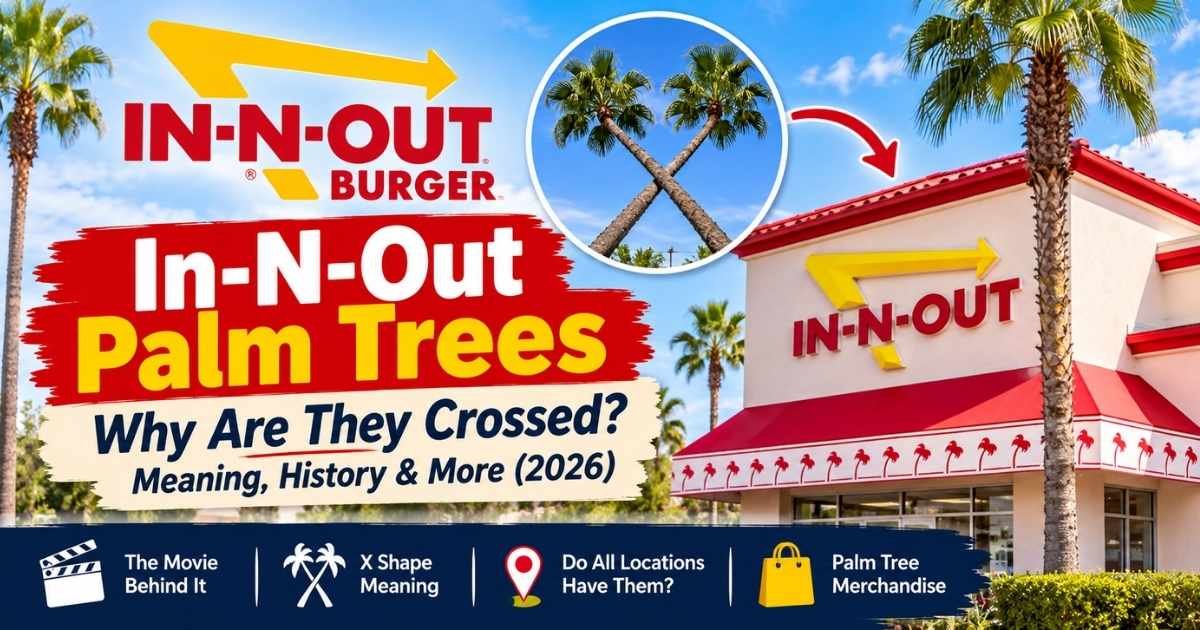
Why Does In-N-Out Have Crossed Palm Trees? In-N-Out plants crossed palm trees out front as a tribute to a movie. Founder Harry Snyder loved the 1963 comedy It’s a Mad, Mad, Mad, Mad World, and he borrowed its buried-treasure joke to mark each restaurant as a treasure of its own. Most locations have the trees, but not all of them, and Tennessee has become the most interesting test case.
The Movie Behind the Palm Trees
In the film, a group of strangers races across California to find a hidden stash of cash buried beneath “a big W.” The payoff comes late: the W turns out to be four palm trees in a park, growing in a shape that spells out the letter.
Snyder opened the first In-N-Out in Baldwin Park, California, in 1948. He liked the idea enough to adapt it. Instead of a W, he used two palms crossed into an X, the classic mark for a spot worth digging. Each restaurant was his treasure, and the trees said so.
The crossing is the whole point. Two straight palms would just be landscaping, but crossed, they read as a symbol. According to the company’s own history, the planting began in 1972.
You may see articles claiming the tradition started in 1961. That can’t be right, because the movie didn’t come out until 1963.
Does Every In-N-Out Have Crossed Palm Trees?
No. In-N-Out’s own wording is careful. The company says it prefers its restaurants to have crossed palms and that most do, while certain climates keep a small number of locations from having them. So the “every” in a lot of search queries is slightly off. Palms are standard in warm regions and harder to manage elsewhere.
Some customers claim that newer restaurants in colder areas planted palms that were later removed or didn’t survive winter. Colorado is the example people mention most. That is fan reporting, not company confirmation, so treat it as anecdotal. An older local news report from Colorado Springs did describe the company’s plan to protect the trees there with heating cables at the base and along the trunks. That suggests the effort goes beyond simply planting them.
In-N-Out Palm Trees in Tennessee
Tennessee is where the tradition meets its toughest test. In 2025, an In-N-Out representative confirmed that the Tennessee restaurants would include the traditional crossed palms. That was a notable commitment, given earlier hints from the company’s social media team that the climate might make it difficult.
The trees went in at the Lebanon site by early September 2025, ahead of the first Tennessee openings. Lebanon and Antioch opened on December 10, 2025, and Murfreesboro followed two days later.
Local experts were skeptical. A nursery owner in nearby Mt. Juliet told WKRN that palms occasionally survive a mild winter but usually die, and that a hard freeze lasting several days will kill them. A fan page for the chain speculated that the trees would need wrapping in winter.
We haven’t found a reliable report on whether the Tennessee palms made it through their first winter, so we won’t claim either way. If you live near Lebanon, Antioch, or Murfreesboro, recent Google Maps photos or a quick visit will tell you more than we can.
The Tennessee expansion has also meant new job openings, covered on our careers page. Tennessee restaurants run the same hours as most other locations, which you can check on our hours page. For the full menu, head to the homepage.
Palm Trees FAQ
Are the palm trees part of In-N-Out’s official logo?
Not the main one. The restaurant’s primary logo is the red and yellow arrow wordmark. The crossed palms work as a companion motif, and food media coverage notes them on awnings, interior wallpaper, and apparel.
Where can I find In-N-Out palm tree merchandise?
In-N-Out runs an official Company Store at shop.in-n-out.com. Stock changes, so check what’s currently listed. Third-party sellers use the palm design too, but the official store is the safest source for genuine items.